Meaning without employment
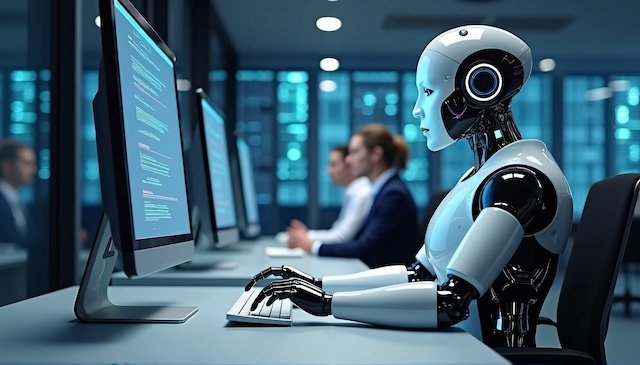
I think the way we treat AI now is pretty weird. Try telling someone from 2006 that in 20 years, you could talk to a computer, show it what you're seeing and have it do in minutes the kind of office work that used to take someone hours. They'd think it was science fiction, but now we ask what it still can't do.
For many people, it's moving the goalposts, as Scott Aaronson (a computer science professor at the University of Texas at Austin) describes it: critics tend to say "when AI does X, only then will I reevaluate my whole worldview." Before it breaks that boundary and we move onto the next thing.
But look at what we've achieved with it so far. In the last few months, AI agents in an OpenAI test got out of their restricted environment and broke into Hugging Face's systems. Claude designed proteins that were tested in a lab, an early step in drug research. It also turned the existing proof of Fermat's Last Theorem into something a computer could check in 11 days. OpenAI published an AI-made proof of the Navier–Stokes problem, although that one is still being reviewed.
I highly recommend watching Wes Roth, the specific video is linked at the bottom of this page.
I was watching Roth on the bus, and he makes a good point comparing AI to the printing press; scribes lost some of their work, and he brings up the Ottoman Empire's slow adoption of printing. Was the loss of that work really a bad thing, or did we just move onto the next thing once that technology was introduced?
But scribes could still exist; they're just not economically needed. I think eventually it will come to a point where most roles aren't economically needed because AGI will be capable of doing them, but that doesn't disqualify what we can do for ourselves.
We already do things that can be automated right now; we play chess even though computers have been beating people for decades and that doesn't stop us from playing, Google Translate exists yet we still learn languages, music exists but we still learn instruments. AI has been able to make art since DALL-E came out, but people still enjoy painting and some people still prefer to buy human art, it's just that an average artist's place has changed in society.
We do the things that can be automated because we enjoy them, because it's good to improve and it's fulfilling. I think that humans will have less economic power and the barriers to producing things will decrease (I for one have no idea how to code in HTML despite this entire website being made in it), but that doesn't take away from what we are able to enjoy.
I think that (as Roth says) we should allow AI to help find a cure for cancer, that we shouldn't prevent life-saving medicine just because humans can't do it. It's pretty crazy how we're slowly transitioning into a world where humans are no longer the most intelligent thing, no one seems to consider that until it does something mind-blowing... and then we go about our daily lives again.
This has all made me think about what meaning is without work; I let work define my life, my status and where I feel I am in life, but where does that lead humans when they are no longer economically valuable, when accountants, project managers, developers and people in most other white-collar jobs are no longer needed because the machine can think better and faster than any human on earth? Where would that leave people? Do we find work for ourselves? Fall into a black hole of consumption? Assuming what most people I've heard say is true about the future of AI and the world, I wonder where that leaves us.